
Over 60 percent of American professionals identify task overload as their biggest productivity barrier. Rapid workdays and endless to-do lists make it easy to fall into the trap of doing more but achieving less. Discover proven strategies that help American workers manage priorities, set realistic deadlines, and maximize efficiency—turning chaotic schedules into clear action plans that drive meaningful results.
Table of Contents
- Prioritize Tasks Using The Eisenhower Matrix
- Break Down Projects Into Manageable Steps
- Set Clear And Achievable Deadlines
- Automate And Delegate Recurring Tasks
- Track Progress With Visual Dashboards
- Review And Adjust Priorities Regularly
- Leverage Seamless Workflows For Team Collaboration
Quick Summary
| Key Message | Explanation |
|---|---|
| 1. Use the Eisenhower Matrix | Categorize tasks by urgency and importance to focus on high-impact activities. |
| 2. Break Projects Into Steps | Decompose large tasks into smaller, manageable actions for better progress. |
| 3. Set Realistic Deadlines | Establish achievable timelines that motivate without overwhelming you. |
| 4. Automate and Delegate Tasks | Identify repetitive tasks to delegate or automate for greater efficiency. |
| 5. Regularly Review Priorities | Reassess your tasks and goals frequently to stay aligned with changing circumstances. |
1. Prioritize Tasks Using the Eisenhower Matrix
Busy professionals constantly struggle with task overload, but the Eisenhower Matrix offers a powerful solution for strategic time management. This method transforms how you approach productivity by categorizing tasks based on their urgency and importance, helping you focus on what truly matters.
The matrix divides your workload into four critical quadrants, creating a simple yet profound framework for decision making. Professional task management strategies demonstrate that this approach allows you to quickly assess which tasks deserve immediate attention and which can be reconsidered or eliminated.
Here’s how the quadrants break down:
Quadrant 1: Do Immediately
- Urgent and important tasks
- Requires immediate action
- Examples: Critical deadlines, emergencies, important meetings
Quadrant 2: Schedule
- Important but not urgent tasks
- Requires planned time allocation
- Examples: Strategic planning, skill development, relationship building
Quadrant 3: Delegate
- Urgent but not important tasks
- Can be assigned to others
- Examples: Some emails, routine administrative work
Quadrant 4: Delete
- Neither urgent nor important tasks
- Should be eliminated
- Examples: Excessive social media browsing, unnecessary meetings
By systematically categorizing your tasks, you create a visual roadmap that prevents burnout and ensures you invest your energy in high impact activities. This approach helps professionals shift from reactive task management to proactive goal achievement.
Pro tip: Review your task list at the start of each week and intentionally move items between quadrants as priorities shift. Flexibility is key to effective time management.
2. Break Down Projects Into Manageable Steps
Successful project completion starts with transforming complex challenges into bite sized tasks that feel approachable and achievable. Task decomposition techniques reveal that breaking down large projects into smaller actionable steps dramatically improves productivity and reduces overwhelm.
Most professionals struggle with massive projects that seem insurmountable at first glance. The key is to deconstruct these complex initiatives into clear actionable components that can be systematically addressed. Think of this approach like building a house one brick at a time rather than attempting to construct the entire structure simultaneously.
Effective Project Breakdown Strategy:
- Start with the End Goal
- Clearly define your ultimate project objective
- Visualize the completed project in detail
- Work backward from the final destination
- Identify Major Milestones
- Create 3-5 significant checkpoints
- Outline broad categories of work required
- Establish realistic timelines for each milestone
- Segment Milestones into Specific Tasks
- Break each milestone into 3-7 concrete actions
- Make tasks specific and measurable
- Assign estimated time requirements
- Prioritize and Sequence Tasks
- Determine logical task order
- Identify dependencies between tasks
- Create a sequential workflow
- Estimate Resource Requirements
- Assess skills needed for each task
- Allocate necessary tools and support
- Identify potential bottlenecks in advance
By systematically deconstructing complex projects into manageable steps, you transform overwhelming challenges into structured pathways to success. This approach reduces psychological barriers and creates momentum through consistent progress.
Pro tip: Use visual project management tools that allow drag and drop task organization, helping you continuously refine and adjust your project breakdown as you progress.
3. Set Clear and Achievable Deadlines
Deadlines are the heartbeat of productivity, transforming abstract goals into concrete achievements. Goal setting strategies reveal that well structured deadlines dramatically increase motivation and performance.
The art of setting achievable deadlines is more nuanced than simply marking a date on the calendar. Professionals must craft deadlines that are challenging yet realistic, creating a sense of urgency without inducing paralyzing stress.
Effective Deadline Setting Framework:
- Assess Task Complexity
- Evaluate the total scope of work required
- Consider potential obstacles and contingencies
- Estimate realistic time needed for completion
- Break Down Intermediate Milestones
- Create smaller checkpoints within the larger deadline
- Assign specific dates for each milestone
- Build buffer time for unexpected challenges
- Use the SMART Criteria
- Specific: Clearly define what needs to be accomplished
- Measurable: Establish concrete criteria for progress
- Achievable: Ensure the goal is within realistic reach
- Relevant: Align deadline with broader project objectives
- Time Bound: Set a precise target date
- Implement Accountability Mechanisms
- Share deadlines with teammates or supervisors
- Use visual tracking tools
- Schedule regular progress check ins
- Build Flexibility Into Your Timeline
- Allow 15 20% buffer time for unexpected complications
- Create contingency plans for potential delays
- Be prepared to adjust timelines strategically
By transforming deadlines from rigid constraints to dynamic planning tools, you create a powerful framework for consistent professional achievement. The goal is not perfection but steady, purposeful progress.
Pro tip: Color code your deadlines using red for critical tasks, yellow for important tasks, and green for flexible tasks to visually prioritize your workflow.
4. Automate and Delegate Recurring Tasks
Professional productivity hinges on recognizing which tasks consume your time without generating meaningful value. Task delegation strategies reveal that systematically automating and delegating recurring tasks can dramatically free up your mental bandwidth for high impact work.
Most professionals waste countless hours performing repetitive tasks that could be easily automated or assigned to team members with appropriate skills. The key is identifying these tasks and implementing smart systems that minimize your direct involvement.
Strategic Task Automation Framework:
- Identify Repetitive Tasks
- Track time spent on routine activities
- List tasks performed weekly or monthly
- Recognize patterns in your workflow
- Evaluate Automation Potential
- Determine which tasks have standardized processes
- Look for digital tools that can replace manual work
- Consider software with recurring task capabilities
- Select Appropriate Delegation Targets
- Identify tasks that do not require your specific expertise
- Match tasks to team members skills
- Establish clear instructions and expectations
- Implement Robust Tracking Systems
- Use project management platforms
- Create templates for recurring assignments
- Set up automated notifications and reminders
- Develop Clear Delegation Protocols
- Document task requirements precisely
- Establish performance benchmarks
- Create feedback loops for continuous improvement
By systematically removing low value tasks from your personal workflow, you create space for strategic thinking and high impact professional growth. Automation and delegation are not about working less but about working smarter.
Pro tip: Conduct a quarterly review of your recurring tasks to continuously refine your automation and delegation strategies, ensuring maximum efficiency and team productivity.
5. Track Progress With Visual Dashboards
Visual dashboards transform abstract data into powerful insights that drive professional performance. Digital task tracking strategies reveal how real time visual representations can revolutionize productivity and decision making.
Most professionals struggle with understanding their progress because traditional tracking methods are complex and unintuitive. Visual dashboards solve this problem by converting scattered information into clear actionable graphics that instantly communicate project status.
Key Components of Effective Visual Dashboards:
- Real Time Progress Indicators
- Track completion percentages
- Show task status at a glance
- Highlight upcoming deadlines
- Performance Metrics
- Visualize productivity trends
- Compare current performance against historical data
- Identify potential bottlenecks
- Color Coded Task Categorization
- Use intuitive color systems
- Green for completed tasks
- Yellow for in progress items
- Red for overdue or critical tasks
- Interactive Data Visualization
- Allow drill down capabilities
- Customize view preferences
- Integrate multiple project perspectives
- Comprehensive Reporting Features
- Generate automated progress reports
- Export data in multiple formats
- Enable team wide visibility
Successful visual dashboards transform raw data into strategic insights that empower professionals to make informed decisions quickly. They serve as mission control centers for your productivity ecosystem.
Pro tip: Spend 10 minutes each morning reviewing your dashboard to align daily activities with overall project goals and identify potential obstacles before they become critical issues.
6. Review and Adjust Priorities Regularly
Professional success demands constant recalibration of your priorities as work environments shift and opportunities emerge. Priority management techniques reveal that regular strategic review prevents task stagnation and maintains peak productivity.
Most professionals fall into the trap of rigidly adhering to outdated plans, missing critical opportunities for optimization. Effective priority management requires a dynamic approach that embraces flexibility and strategic reassessment.
Comprehensive Priority Review Framework:
- Schedule Regular Review Sessions
- Conduct weekly priority assessments
- Block dedicated time for strategic planning
- Create consistent review rhythms
- Evaluate Current Task Landscape
- Assess completed and pending tasks
- Analyze alignment with broader goals
- Identify emerging high priority items
- Implement Adaptive Prioritization
- Use flexible task categorization systems
- Remain open to unexpected opportunities
- Adjust timelines based on changing circumstances
- Conduct Honest Performance Audits
- Measure actual task completion rates
- Identify persistent bottlenecks
- Recognize personal productivity patterns
- Create Contingency Strategies
- Develop backup plans for key projects
- Build buffer time into critical workflows
- Anticipate potential disruption scenarios
Successful professionals understand that priorities are not static blueprints but living documents that require continuous refinement. Your ability to adapt quickly separates exceptional performers from average workers.
Pro tip: Keep a dynamic task list that allows instant reprioritization, using visual tools that enable drag and drop task reorganization for maximum flexibility.
7. Leverage Seamless Workflows for Team Collaboration
Modern professional success depends on transforming individual efforts into synchronized team performance. Collaborative workflow strategies demonstrate that seamless communication and task alignment are critical for achieving collective goals.
Team collaboration is more than simply working together. It requires creating integrated systems that enable transparent communication, clear task ownership, and synchronized productivity across diverse skill sets and work styles.
Strategic Team Workflow Architecture:
- Establish Clear Communication Protocols
- Define preferred communication channels
- Set response time expectations
- Create transparent information sharing guidelines
- Implement Centralized Project Management
- Use unified digital collaboration platforms
- Ensure real time task tracking
- Enable instant status updates
- Define Precise Role Boundaries
- Clarify individual responsibilities
- Create accountability mechanisms
- Minimize task overlap and confusion
- Design Collaborative Task Handoff Processes
- Develop standardized task transition scripts
- Create comprehensive documentation templates
- Establish quality control checkpoints
- Foster Psychological Safety
- Encourage open feedback
- Normalize discussing challenges
- Create supportive team environments
Successful team workflows transform potential friction points into opportunities for collective achievement. The goal is creating an ecosystem where individual talents combine seamlessly toward shared objectives.
Pro tip: Schedule monthly workflow optimization meetings where team members can collaboratively review and refine collaboration processes, ensuring continuous improvement and adaptation.
This table summarizes key time management and productivity strategies for professionals, focusing on techniques such as the Eisenhower Matrix, project breakdown, deadline setting, automation, visual dashboards, priority adjustment, and team collaboration.
| Strategy | Implementation | Expected Results |
|---|---|---|
| Eisenhower Matrix | Use four quadrants to categorize tasks by urgency and importance. | Focus on high-impact activities, reduce burnout. |
| Project Breakdown | Break projects into smaller, actionable steps with clear milestones. | Achieve complex goals systematically, reduce overwhelm. |
| Set Deadlines | Apply SMART criteria and assess task complexity for deadlines. | Increase motivation, ensure timely goal achievement. |
| Automate & Delegate | Identify and automate repetitive tasks, delegate nonessential work. | Free up time for strategic activities, enhance productivity. |
| Visual Dashboards | Use real-time dashboards for tracking progress and performance. | Gain insights quickly, make informed decisions. |
| Review Priorities | Schedule regular reviews to adjust tasks based on shifting priorities. | Maintain peak productivity, seize opportunities. |
| Team Collaboration | Establish clear protocols and centralized management for teamwork. | Improve workflow efficiency, achieve collective goals. |
Master Your Task Management with TaskQuadrant.io
The article highlights common challenges professionals face such as task overload, difficulty in prioritizing urgent and important tasks, and managing complex projects effectively. You need a simple solution that helps categorize your work, automate repetitive tasks, and track progress visually to maintain focus and reduce decision fatigue. Concepts like the Eisenhower Matrix, deadline setting, and visual dashboards are essential but often complicated to implement manually.
TaskQuadrant.io is designed precisely to solve these pain points by automatically sorting your tasks into four clear quadrants based on urgency and importance, making prioritization intuitive. Its features include goal setting, progress tracking through visual dashboards, and automation of recurring tasks to save your valuable time. The platform’s simplicity and seamless workflows let you spend less time organizing and more time achieving. Whether you are managing individual goals or collaborating with a team, TaskQuadrant.io equips you with the tools to boost productivity efficiently.
Begin transforming your workday today with TaskQuadrant.io
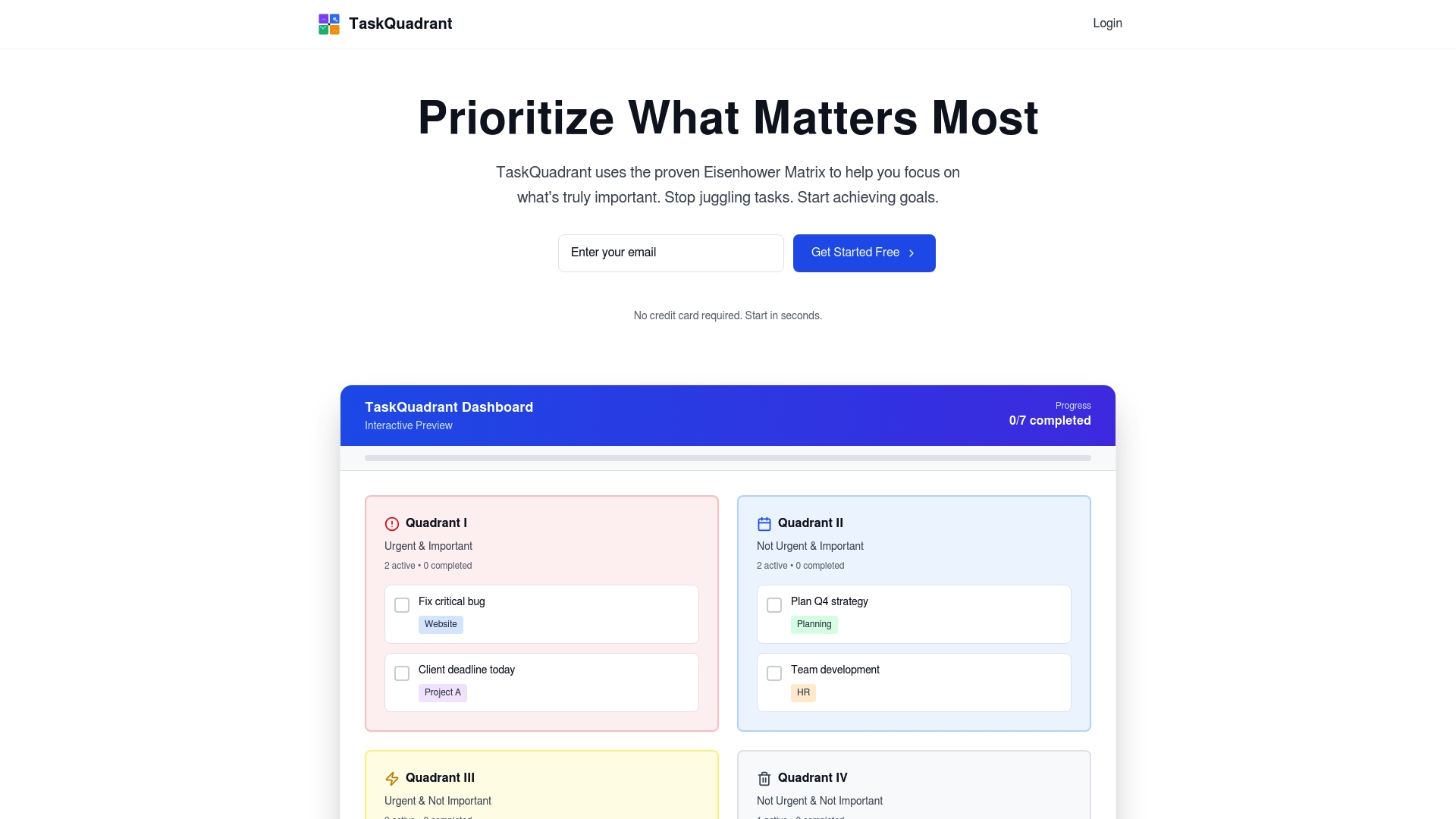
Take control of your productivity now by trying the platform that turns complex task management into a clear, actionable process. Visit TaskQuadrant.io to start your free plan and experience how prioritizing tasks effectively leads to meaningful results.
Frequently Asked Questions
How can I prioritize tasks using the Eisenhower Matrix?
You can prioritize tasks by categorizing them into four quadrants based on urgency and importance. Start by making a list of your tasks, then place each one in the appropriate quadrant to decide which to address immediately, schedule, delegate, or delete.
What are effective ways to break down a project into manageable steps?
To break down a project, start by clearly defining your end goal and then identify major milestones. Segment these into specific tasks, prioritize them logically, and create a timeline to follow.
How do I set clear and achievable deadlines for my tasks?
To set achievable deadlines, assess the complexity of each task and break it down into smaller milestones with specific dates. Use the SMART criteria to ensure your deadlines are specific, measurable, achievable, relevant, and time-bound.
What tasks should I consider automating or delegating?
Identify repetitive tasks that consume a lot of your time but do not require your specific expertise, such as routine administrative work. Once identified, look for tools to automate these tasks or delegate them to team members who can handle them effectively.
How can I track my progress visually?
You can track progress visually by creating a dashboard that includes real-time updates, performance metrics, and color-coded task statuses. Spend a few minutes each day reviewing this dashboard to align your daily activities with your overall project goals.
Why is it important to regularly review and adjust my priorities?
Regularly reviewing and adjusting your priorities is crucial because it allows you to adapt to changing work environments and seize emerging opportunities. Schedule dedicated time each week to reassess your tasks and make necessary adjustments to stay on track.
Recommended
- TaskQuadrant Features – Eisenhower Matrix, Projects & Analytics
- TaskQuadrant – Professional Task Management with Eisenhower Matrix
- TaskQuadrant Landing – Eisenhower Matrix Task Management
- Why Automate WordPress Tasks for Business Efficiency – WPCTO
- 7 Steps to a Proven Sales Performance Improvement Checklist
Leave a Reply