
Most American professionals spend nearly half their workweek on low-value tasks, yet clear priorities could change everything. In a world where distractions multiply by the minute, understanding how to define objectives and organize your workflow becomes critical to staying ahead. This guide reveals proven strategies that will help you turn overwhelming task lists into focused, productive action that delivers real results.
Table of Contents
- 1. Define Clear Project Objectives For Each Task
- 2. Categorize Tasks Using The Eisenhower Matrix
- 3. Break Down Large Tasks Into Manageable Steps
- 4. Set Realistic Deadlines And Assign Priorities
- 5. Leverage Visual Tools For Progress Tracking
- 6. Automate Recurring Tasks For Consistency
- 7. Review And Optimize Your Checklist Regularly
Quick Summary
| Key Message | Explanation |
|---|---|
| 1. Define SMART Objectives | Set specific, measurable goals for each task using the SMART framework to enhance clarity and focus. |
| 2. Use the Eisenhower Matrix | Prioritize tasks based on urgency and importance to improve productivity and clear focus on critical tasks. |
| 3. Break Tasks into Steps | Decompose large projects into smaller, manageable components to reduce overwhelm and facilitate progress. |
| 4. Set Realistic Deadlines | Establish achievable timelines for tasks and projects by factoring in complexity and using backward planning. |
| 5. Regularly Review Checklists | Continuously optimize your task management process and workflows through systematic performance assessments and adjustments. |
1. Define Clear Project Objectives for Each Task
Successful task management begins with crystal clear project objectives that transform abstract goals into actionable steps. When you define precise objectives for each task, you create a strategic roadmap that eliminates guesswork and drives focused productivity.
Objectives serve as the strategic compass for your entire project workflow. Without well defined objectives, tasks become scattered and team efforts can quickly become misaligned. By establishing specific, measurable goals upfront, you provide your team with a shared understanding of what needs to be accomplished and why.
To craft effective project objectives, use the SMART framework: Specific, Measurable, Achievable, Relevant, and Time bound. This approach ensures your objectives are not just wishful thinking but concrete targets with clear milestones. For instance, instead of saying “improve sales”, a SMART objective would read “Increase quarterly sales revenue by 15% through targeted digital marketing campaigns by December 31st”.
Break down complex objectives into smaller, manageable subtasks that create a logical progression. This approach helps team members understand their individual responsibilities and how their work contributes to the larger project goals. Visual tools like task management dashboards can help track these objectives and maintain team alignment.
When documenting objectives, include key details such as expected outcomes, required resources, potential constraints, and success metrics. This comprehensive approach provides context and helps team members understand the full scope of their responsibilities.
Pro Tip: Schedule quarterly objective review meetings to assess progress, adjust strategies, and realign tasks with evolving project needs. These check ins ensure your project remains dynamic and responsive to changing circumstances.
2. Categorize Tasks Using the Eisenhower Matrix
The Eisenhower Matrix transforms task management from overwhelming chaos into a strategic prioritization system that separates urgent work from truly important work. By visually mapping tasks across four distinct quadrants, you gain unprecedented clarity about where to focus your limited time and energy.
This powerful method categorizes tasks based on two critical dimensions: urgency and importance. The matrix creates four distinct quadrants that help you understand the real priority of each task you encounter. These quadrants range from critical activities you must do immediately to tasks that should be eliminated completely.
The four quadrants break down as follows:
Quadrant 1: Urgent and Important • Emergencies • Critical deadlines • Immediate problem solving tasks
Quadrant 2: Important but Not Urgent • Strategic planning • Personal development • Long term goal activities
Quadrant 3: Urgent but Not Important • Interruptions • Some meetings • Certain communication requests
Quadrant 4: Neither Urgent nor Important • Time wasting activities • Excessive social media • Trivial tasks
Implementing the Eisenhower Matrix task management approach requires honest self assessment and disciplined categorization. Most professionals discover they spend too much time in Quadrants 3 and 4, which drain productivity and prevent meaningful progress.
To apply this method effectively, review your current task list and deliberately place each item into its appropriate quadrant. Focus maximum energy on Quadrant 2 activities these are the strategic tasks that drive long term success but often get neglected amid daily urgencies.
Pro Tip: Color code your task matrix to create visual differentiation between quadrants. Use red for urgent tasks, green for important activities, and yellow for tasks requiring careful evaluation.
3. Break Down Large Tasks Into Manageable Steps
Large projects can feel overwhelming when viewed as a monolithic challenge. Breaking complex tasks into smaller actionable steps transforms intimidating work into achievable progress by making each component feel more approachable and less daunting.
The psychological impact of task fragmentation cannot be overstated. Manpower estimation tools reveal that complex projects often require strategic decomposition to optimize workflow and reduce individual task complexity. By dividing substantial projects into granular steps, you create a clear roadmap that minimizes mental resistance and accelerates overall productivity.
Effective Task Breakdown Strategies:
- Identify the Ultimate Goal • Understand the final objective • Clarify desired end result
- Create Major Milestones • Segment project into 3-5 primary phases • Establish clear transition points
- Define Specific Subtasks • Break each milestone into actionable items • Estimate time required for each subtask
- Sequence Subtasks Logically • Determine prerequisite activities • Establish dependency relationships
- Assign Realistic Timeframes • Estimate duration for each subtask • Build in buffer time for unexpected challenges
The most successful project managers recognize that granular task decomposition reduces psychological friction. By transforming abstract goals into concrete steps, you create a sense of momentum that propels continuous progress.
When approaching a complex project, start by writing down the ultimate objective. Then systematically deconstruct that goal into smaller components that feel manageable and less intimidating. Each subtask becomes a mini achievement that builds confidence and motivation.
Pro Tip: Use visual tracking methods like kanban boards or digital task management platforms to monitor progress across your broken down tasks. Seeing incremental advancement provides powerful psychological motivation to continue pushing forward.
4. Set Realistic Deadlines and Assign Priorities
Deadline setting is a critical skill that separates successful professionals from those perpetually playing catch up. Establishing realistic timelines requires a nuanced approach that balances ambition with practical constraints and individual work rhythms.
Strategic Deadline Setting Framework:
- Understand Task Complexity • Assess actual time requirements • Consider potential unexpected challenges • Factor in resource availability
- Use Backward Planning • Start with final project deadline • Work backward to create intermediate milestones • Build buffer time into each stage
- Prioritization Techniques • Apply Eisenhower Matrix principles • Distinguish between urgent and important tasks • Allocate energy proportionally
Professionals who master task management with strategic deadline approaches understand that realistic timelines are not about working harder but working smarter. By creating achievable schedules, you reduce stress and increase the likelihood of consistent project completion.
Consider implementing the 80/20 rule when prioritizing tasks. This principle suggests that 20% of your efforts typically produce 80% of your results. Identify and focus on those high impact activities that drive meaningful progress.
When assigning priorities, create a visual ranking system. Use numbered categories or color coding to distinguish task importance. Red might indicate critical urgent tasks while green represents strategic long term objectives.
Pro Tip: Schedule weekly priority review sessions to reassess task timelines and adjust expectations proactively. This practice allows for dynamic scheduling and prevents deadline burnout.
5. Leverage Visual Tools for Progress Tracking
The human brain processes visual information exponentially faster than text or numerical data. Visual progress tracking transforms abstract project metrics into intuitive, immediately comprehensible insights that motivate and guide your workflow.
Core Visual Tracking Strategies:
- Kanban Boards • Visualize task progression • Show work stages clearly • Enable instant status understanding
- Progress Bar Techniques • Display percentage completion • Provide psychological motivation • Highlight incremental achievements
- Color Coded Systems • Red for blocked tasks • Yellow for in progress work • Green for completed items
Modern task management dashboards revolutionize how professionals monitor project advancement. By converting complex workflows into graphical representations, these tools eliminate communication barriers and provide transparent performance insights.
Visualization methods tap into powerful psychological triggers. When you see tangible progress represented graphically, your brain releases dopamine reinforcing positive work behaviors. This neurological reward mechanism transforms tracking from a mundane administrative task into an engaging motivation strategy.
Key visualization principles include simplicity, consistency, and real time updates. Choose tools that offer customizable views allowing you to zoom in on granular details or zoom out for comprehensive project perspectives. The goal is creating an intuitive visual language that communicates project status instantly.
Pro Tip: Implement a weekly visual review ritual where you analyze your progress tracking dashboard. Screenshot your progress to create a motivational portfolio documenting your professional growth and project achievements.
6. Automate Recurring Tasks for Consistency
Automation transforms repetitive work from tedious manual labor into streamlined productivity. By creating systematic processes for recurring tasks, professionals can reclaim significant time and mental energy previously consumed by routine activities.
Key Automation Strategies:
- Identify Repetitive Workflows • Weekly reporting • Invoice processing • Email responses • Data entry tasks
- Select Appropriate Automation Tools • Workflow management platforms • Scheduling software • Integration applications • Templating systems
- Design Consistent Execution Protocols • Create standard templates • Establish clear trigger points • Define outcome expectations • Build quality control checkpoints
Professionals who master task automation techniques understand that consistency is the foundation of high performance. By removing manual intervention from predictable tasks, you minimize human error and create reliable operational rhythms.
Automation goes beyond simple time saving. It represents a strategic approach to work design that allows you to redirect cognitive resources toward creative problem solving and strategic thinking. Each automated process becomes a micro efficiency engine driving overall productivity.
When implementing automation strategies, start small. Choose one recurring task with clear parameters and design a systematic approach. Gradually expand your automation ecosystem as you gain confidence and understand potential workflow improvements.
Pro Tip: Conduct a quarterly automation audit to review and refine your automated processes. Technology and work requirements evolve constantly, so your automation strategies should remain dynamic and adaptable.
7. Review and Optimize Your Checklist Regularly
Task management is not a static process but a dynamic journey of continuous improvement. Regular checklist optimization transforms your productivity system from a rigid framework into an adaptive strategy that evolves with your changing professional landscape.
Systematic Review Approach:
- Quarterly Performance Assessment • Analyze task completion rates • Identify workflow bottlenecks • Evaluate time spent on different activities
- Metrics Based Optimization • Track task success percentages • Measure time efficiency • Calculate resource allocation
- Iterative Refinement Process • Remove unnecessary steps • Streamline complex workflows • Add new productivity techniques
Professionals who master task management optimization understand that productivity systems are living organisms requiring consistent nurturing and strategic adjustment. Your checklist should not remain static but dynamically respond to your evolving work demands and personal growth.
Think of your task management approach like a high performance athlete continuously fine tuning their training regimen. Small incremental improvements compound over time creating significant performance gains. By implementing a structured review process, you transform your checklist from a simple to do list into a sophisticated productivity ecosystem.
Consider creating a dedicated review session at the end of each quarter. During this time systematically deconstruct your current workflow. Ask critical questions about what is working well and what needs modification. Document your insights and experiment with new approaches to task management.
Pro Tip: Maintain a running document of workflow experiments and their outcomes. This personal productivity journal will become an invaluable resource for understanding your most effective work strategies over time.
Below is a comprehensive table summarizing the key strategies and steps for effective task and project management discussed throughout the article.
| Strategy/Step | Key Actions | Benefits/Outcomes |
|---|---|---|
| Define Clear Project Objectives | Use SMART framework; Document objectives with details | Aligned team efforts; Measurable progress |
| Categorize Tasks with Eisenhower Matrix | Map tasks by urgency and importance; Focus on Quadrant 2 activities | Improved prioritization; Focus on long-term success |
| Break Down Large Tasks | Identify goals; Create milestones and subtasks; Assign timeframes | Reduced overwhelm; Increased productivity |
| Set Realistic Deadlines | Assess complexity; Use backward planning; Apply prioritization techniques | Achievable schedules; Reduced stress |
| Leverage Visual Tools | Use Kanban boards; Implement color-coded systems; Track progress visually | Enhanced motivation; Clear project status |
| Automate Recurring Tasks | Identify workflows; Choose automation tools; Establish execution protocols | Consistent execution; Time savings |
| Review and Optimize Checklist | Conduct quarterly assessments; Optimize based on metrics; Iterate and refine | Continuous improvement; Adaptive strategy to evolving work needs |
Transform Your Task Management with TaskQuadrant.io
The challenge of creating an effective task management checklist lies in clear prioritization, realistic deadlines, and maintaining consistent progress. This article highlights how breaking down tasks, using the Eisenhower Matrix, and leveraging visual tracking can help reduce overwhelm and boost productivity. If you want to take these principles further and eliminate decision fatigue, our platform can help.
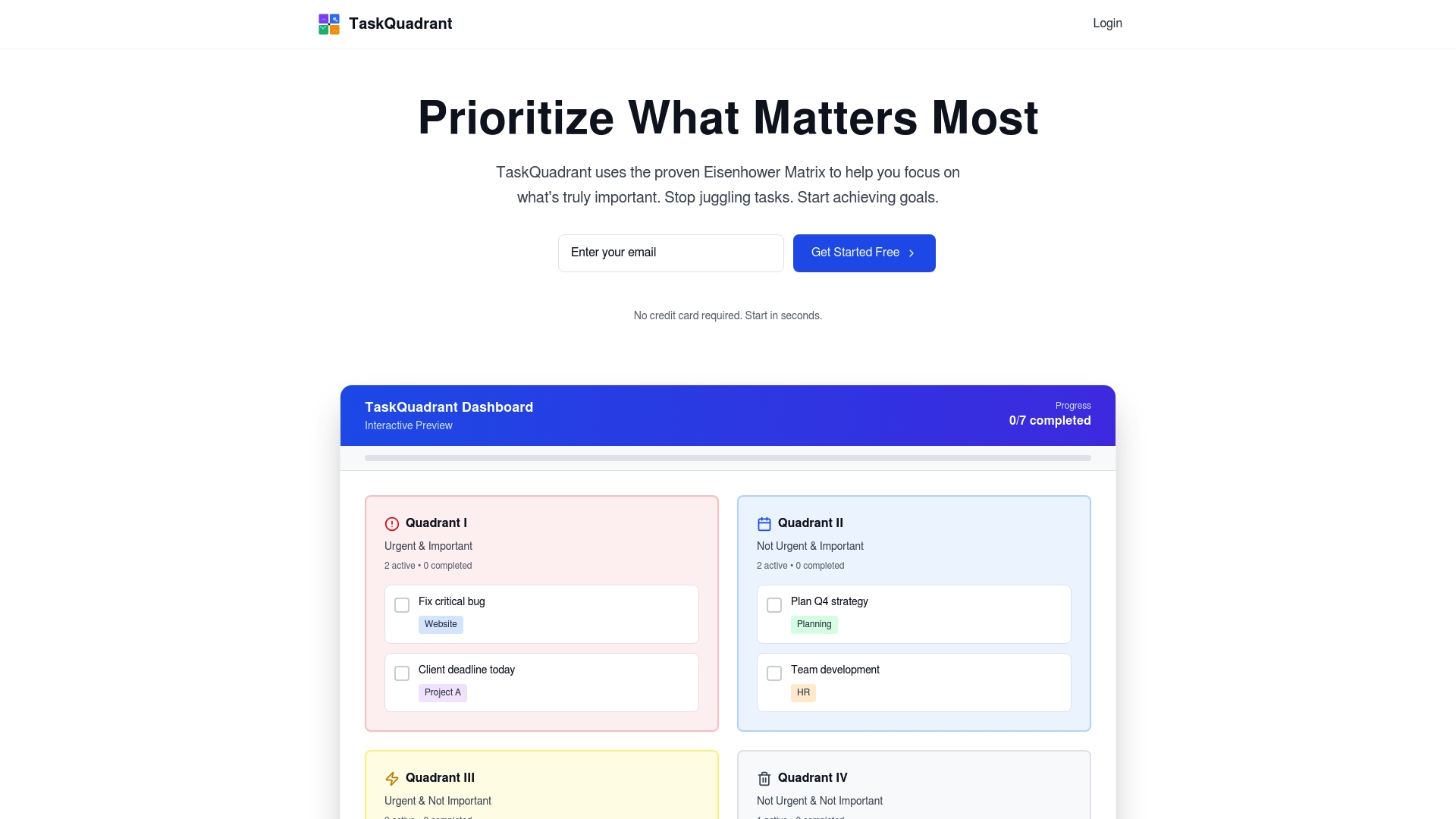
Discover how TaskQuadrant.io brings these essential steps to life with powerful automation of recurring tasks, advanced visual dashboards, and intuitive task categorization using the Eisenhower Matrix. Designed for professionals and teams seeking real results, our tools simplify project organization and keep your goals front and center. Start prioritizing smarter today by exploring how TaskQuadrant.io’s landing page can help you build a checklist that drives success. Don’t wait to turn task management frustration into focused achievement.
Frequently Asked Questions
What are the first steps to create an effective task management checklist?
Start by defining clear project objectives for each task. Use the SMART framework to transform your goals into specific, measurable, achievable, relevant, and time-bound targets.
How can I prioritize tasks effectively within my checklist?
Utilize the Eisenhower Matrix to categorize tasks based on urgency and importance. Focus on tasks in the Important but Not Urgent quadrant to drive long-term success.
What techniques can I use to break down large projects into manageable steps?
Decompose large tasks into smaller, actionable subtasks by identifying the ultimate goal and creating major milestones. Ensure each subtask has a clear timeframe and logical sequence to follow.
How can I ensure my deadlines are realistic and achievable?
Assess the complexity of tasks, use backward planning, and incorporate buffer time for unexpected challenges. Regularly review your deadlines to maintain a manageable workflow and adjust expectations as needed.
What visual tools can I incorporate into my task management system?
Consider utilizing kanban boards, progress bars, and color-coded systems to visualize task status. These visualizations improve clarity and accountability, keeping your team engaged.
How often should I review and optimize my task management checklist?
Aim to conduct a quarterly performance assessment of your checklist. Regularly refine your processes by removing unnecessary steps, streamlining workflows, and adding new productivity techniques.
Recommended
- TaskQuadrant Features – Eisenhower Matrix, Projects & Analytics
- TaskQuadrant – Professional Task Management with Eisenhower Matrix
- TaskQuadrant Landing – Eisenhower Matrix Task Management
- 7-Step Website Maintenance Checklist for WordPress Success – WPCTO
- Team Development Explained: Stages, Tools, and Best Practices – Blog
- Project Management Checklist: Boost Team Efficiency Fast – Optio Station: Best Project Management App for Prioritization
Leave a Reply