
Over 60 percent of American workers now rely on digital productivity tools to keep projects on track. Facing tight deadlines and collaborative demands, professionals must monitor their progress more closely than ever. Understanding how to effectively measure and visualize achievement can make the difference between clarity and confusion. This article unpacks the methods and benefits of progress tracking, offering insights to help anyone turn complex goals into clear, measurable results.
Table of Contents
- Defining Progress Tracking In Productivity Tools
- Methods And Types Of Progress Tracking Systems
- Benefits For Individuals, Teams, And Projects
- Integrating Progress Tracking With The Eisenhower Matrix
- Common Pitfalls And How To Overcome Them
Key Takeaways
| Point | Details |
|---|---|
| Effective Progress Tracking Enhances Productivity | Implementing structured progress monitoring helps individuals and teams translate vague goals into measurable achievements, leading to optimized workflows. |
| Diverse Tracking Methodologies Exist | Various systems, such as Earned Value Management and predictive analytics, provide insights into project advancement and allow for proactive performance management. |
| Visual Tools Improve Awareness | Modern productivity tools utilize algorithms and visual interfaces to offer real-time insights, enhancing clarity on task completion and efficiency. |
| Integration with Prioritization Frameworks Boosts Efficiency | Combining progress tracking with frameworks like the Eisenhower Matrix allows for adaptive task management and improved prioritization strategies. |
Defining Progress Tracking in Productivity Tools
Progress tracking represents a systematic approach to monitoring task completion, performance metrics, and goal advancement within professional environments. At its core, this methodology transforms abstract work objectives into measurable, observable milestones that enable individuals and teams to understand their real-time productivity trajectory. By implementing structured progress monitoring techniques, professionals can transform vague aspirations into concrete, trackable achievements.
Modern productivity tools leverage advanced algorithms and visual interfaces to capture granular performance data. These systems typically integrate features like task status indicators, time tracking, completion percentages, and goal progression visualizations. User-centered design principles have revolutionized how these tools capture and present productivity insights, moving beyond simple checklists to comprehensive performance analytics that provide actionable intelligence about work patterns and efficiency.
The fundamental components of effective progress tracking include real-time status updates, comparative performance metrics, trend analysis, and predictive projections. By breaking down complex projects into trackable segments, professionals can maintain clarity, reduce decision fatigue, and systematically advance toward their objectives. Visibility becomes the key mechanism through which individuals transform potential into tangible results, turning abstract goals into methodical, measurable progress. Tracking tools now offer unprecedented transparency, enabling workers to understand not just what they’ve accomplished, but how they can optimize their workflow for maximum productivity.
Key elements of comprehensive progress tracking encompass:
- Automatic task status updates
- Performance trend visualization
- Goal completion percentage tracking
- Time allocation insights
- Comparative performance metrics
Through strategic implementation of these tracking mechanisms, professionals can transform their approach to work, converting passive effort into strategic, data-driven achievement.
Methods and Types of Progress Tracking Systems
Progress tracking systems encompass a diverse range of methodologies designed to measure and monitor project advancement across various professional domains. Application Usability Levels (AUL) framework represents a sophisticated approach that categorizes tracking methods based on their complexity, granularity, and strategic implementation. These systems range from simple task completion checkers to advanced predictive analytics platforms that offer nuanced insights into workflow dynamics.
One prominent method of progress tracking is Earned Value Management (EVM), a robust technique that objectively measures project performance by integrating scope, schedule, and cost parameters. Quantitative tracking systems typically employ metrics like planned value, actual cost, and earned value to provide a comprehensive view of project health. These approaches enable professionals to identify potential bottlenecks, forecast potential delays, and make data-driven strategic adjustments in real time.
Modern progress tracking methodologies can be categorized into several key types:
- Quantitative Metrics Tracking
- Qualitative Performance Assessment
- Predictive Analytics Tracking
- Real-time Collaborative Monitoring
- Automated Progress Visualization
Technology-driven tracking systems now leverage machine learning algorithms and advanced visualization tools to transform raw performance data into actionable insights. By integrating multiple data points and creating dynamic dashboards, these systems provide unprecedented transparency into individual and team productivity. Professionals can now move beyond traditional tracking methods, utilizing sophisticated platforms that not only record progress but also suggest optimization strategies and predict potential workflow challenges.
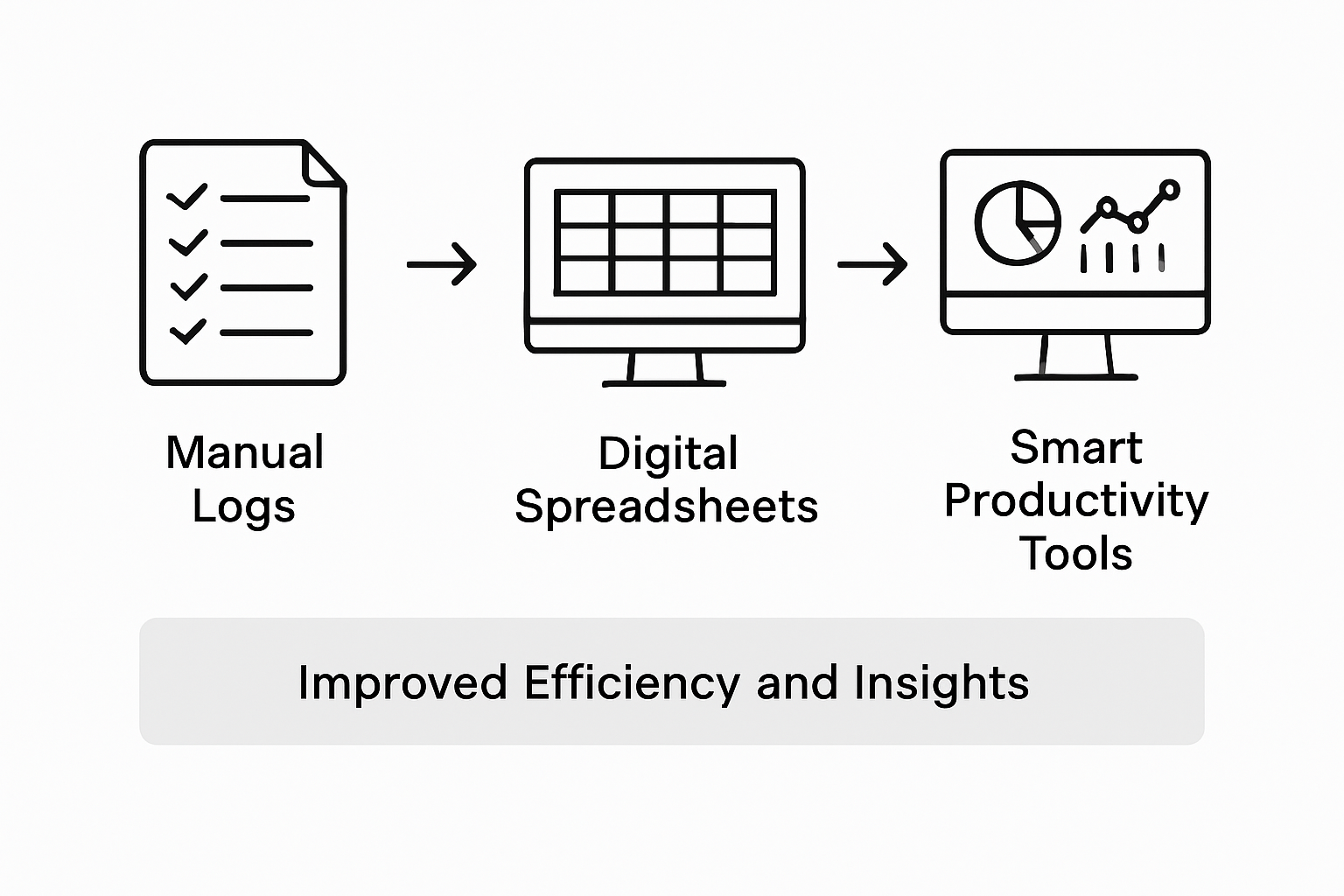
The evolution of progress tracking reflects a fundamental shift from passive documentation to active performance management. Modern tools don’t just record what has been done; they provide intelligent, forward-looking perspectives that help professionals strategically navigate complex work environments. By embracing these advanced tracking methodologies, teams can transform data into a powerful strategic asset, driving continuous improvement and organizational excellence.
Benefits for Individuals, Teams, and Projects
Progress tracking delivers transformative benefits across multiple professional dimensions, empowering individuals, teams, and entire organizational ecosystems. Collaborative project interaction logs reveal how systematic monitoring can dramatically improve performance, accountability, and strategic alignment. By providing transparent, measurable insights into work processes, these tracking mechanisms create a comprehensive framework for understanding and optimizing professional productivity.

At the individual level, progress tracking enables professionals to gain unprecedented visibility into their personal performance metrics. Performance visualization allows workers to identify strengths, recognize potential improvement areas, and develop targeted strategies for enhanced efficiency. The Balanced Scorecard methodology demonstrates how granular tracking can transform abstract goals into concrete, actionable milestones, helping individuals maintain focus and motivation throughout complex projects.
Teams and organizational units benefit from progress tracking through enhanced communication, alignment, and collective accountability. These systems create shared understanding by:
- Establishing clear performance benchmarks
- Facilitating real-time collaborative insights
- Enabling data-driven decision making
- Promoting transparent communication
- Identifying potential bottlenecks proactively
The strategic implementation of progress tracking transcends traditional performance management. Modern tracking approaches integrate advanced analytics, machine learning algorithms, and intuitive visualization tools to provide comprehensive insights. By converting raw data into actionable intelligence, organizations can create adaptive, responsive workflows that continuously optimize individual and collective performance. This evolution represents a fundamental shift from reactive reporting to proactive performance enhancement, empowering professionals to navigate increasingly complex work environments with unprecedented clarity and strategic precision.
Integrating Progress Tracking With the Eisenhower Matrix
The Eisenhower Matrix provides a powerful framework for task prioritization that becomes exponentially more effective when integrated with comprehensive progress tracking mechanisms. Progress, Plans, Problems (PPP) management techniques complement the matrix by offering structured methods for monitoring task advancement across different priority quadrants. This integration transforms the matrix from a static prioritization tool into a dynamic performance optimization system.
Quadrant-specific tracking enables professionals to monitor progress with unprecedented granularity. By applying targeted tracking approaches to each quadrant, individuals can develop nuanced strategies for managing urgent, important, non-urgent, and low-priority tasks. Getting Things Done methodologies further enhance this approach by providing additional frameworks for task management and workflow optimization.
The integration process involves several key strategic approaches:
- Assigning specific tracking metrics to each quadrant
- Creating visual dashboards that reflect matrix categorizations
- Implementing real-time progress monitoring
- Establishing adaptive prioritization protocols
- Generating quadrant-specific performance reports
Advanced progress tracking transforms the Eisenhower Matrix from a conceptual framework into a living, adaptive system of professional productivity. By combining visual prioritization with granular performance monitoring, professionals can create a holistic approach to task management that dynamically adjusts to changing work environments. This integration represents a sophisticated approach to personal and professional productivity, enabling individuals to move beyond simple task lists and develop strategic, data-driven workflow optimization techniques.
Common Pitfalls and How to Overcome Them
Remote worker experiences with task management tools reveal numerous challenges that can undermine effective progress tracking. Tracking system failures often emerge from fundamental misunderstandings about implementation, measurement, and personal productivity dynamics. Professionals frequently encounter obstacles that transform potentially powerful tracking mechanisms into sources of frustration and diminished performance.
The most prevalent pitfalls in progress tracking include:
- Over-complicated tracking systems
- Inconsistent data entry
- Lack of meaningful metrics
- Excessive time spent on tracking
- Neglecting qualitative performance indicators
Longitudinal research using diary studies demonstrates that successful progress tracking requires a nuanced, adaptive approach. Strategic mitigation involves developing flexible tracking systems that balance quantitative measurement with qualitative insights. Professionals must create frameworks that provide meaningful data without becoming burdensome administrative tasks that consume valuable productive time.
Overcoming these challenges requires a multifaceted strategy. Effective progress tracking demands continuous refinement, personalized approaches, and a deep understanding of individual and organizational productivity patterns. Successful implementers recognize that tracking is not about creating additional work, but about generating actionable insights that streamline performance and illuminate potential improvement pathways. By adopting a dynamic, responsive approach to progress monitoring, professionals can transform potentially restrictive tracking systems into powerful tools for personal and professional growth.
Unlock True Productivity With Smart Progress Tracking
The article highlights common challenges professionals face with progress tracking including overwhelming systems, inconsistent data entry, and lack of meaningful insights. It stresses the importance of integrating structured approaches like the Eisenhower Matrix and displaying clear, real-time progress to stay focused and motivated. If you often feel stuck amid complex workflows or struggle to prioritize tasks effectively while tracking progress, a solution that simplifies these processes can transform your productivity.
TaskQuadrant.io is designed precisely to overcome these barriers by combining powerful progress tracking with intuitive task prioritization based on the Eisenhower Matrix. With automated quadrant categorization, visual dashboards, and goal setting features, TaskQuadrant.io helps you maintain clarity and momentum without added complexity. Explore how its straightforward interface supports recurring task automation, project timeline visualization, and performance reporting to keep both individuals and teams aligned and accountable.
Start enhancing your productivity today by visiting TaskQuadrant.io.
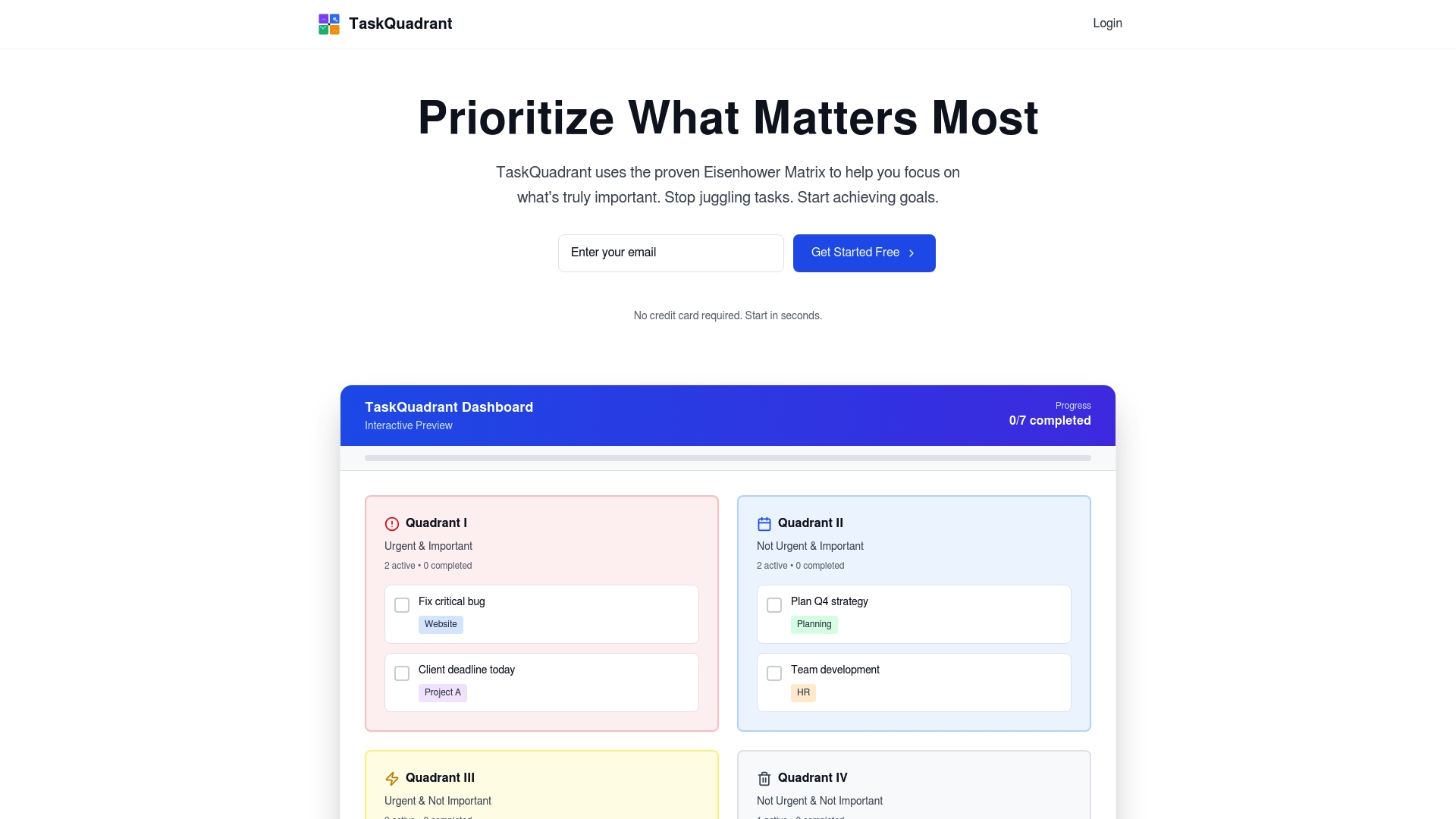
Take control of your professional workflow and reduce decision fatigue. Try TaskQuadrant.io now and see how easy smart progress tracking and effective task management can be.
Frequently Asked Questions
What is progress tracking in professional productivity?
Progress tracking is a systematic approach to monitoring task completion, performance metrics, and goal advancement, transforming abstract objectives into measurable milestones that help individuals and teams assess their productivity.
What are the key components of effective progress tracking?
Key components include real-time status updates, performance trend visualization, goal completion percentage tracking, time allocation insights, and comparative performance metrics, all of which enhance clarity and decision-making.
How can progress tracking methods improve team collaboration?
Progress tracking systems enhance team collaboration by establishing clear performance benchmarks, facilitating real-time insights, enabling data-driven decisions, promoting transparent communication, and proactively identifying potential bottlenecks.
What are common pitfalls to avoid in progress tracking?
Common pitfalls include over-complicating tracking systems, inconsistent data entry, lack of meaningful metrics, excessive time spent on tracking, and neglecting qualitative performance indicators. To overcome these, focus on creating flexible, user-friendly systems that deliver actionable insights.
Leave a Reply