
Most American professionals report feeling overwhelmed by their daily workload, yet only a fraction use structured task strategies to cope. Understanding how to separate urgent demands from what truly matters can change the game—not just for productivity but for peace of mind. By exploring proven frameworks for categorizing tasks, you can discover practical ways to reclaim focus and direct your energy toward the goals that create real value.
Table of Contents
- Defining Task Quadrants And Core Principles
- Breaking Down The Four Distinct Quadrants
- How Task Quadrant Prioritization Works
- Real-World Productivity Applications And Benefits
- Pitfalls And Common Mistakes To Avoid
Key Takeaways
| Point | Details |
|---|---|
| Utilize Task Quadrants | Employ the task quadrant system to categorize tasks based on urgency and importance, leading to effective prioritization. |
| Focus on Quadrant 2 | Prioritize tasks in Quadrant 2 (important but not urgent) to drive long-term growth and minimize crises. |
| Regular Self-Audits | Conduct weekly and monthly reviews of task categorization to enhance accuracy and adapt strategies as needed. |
| Avoid Common Pitfalls | Be mindful of misclassifying tasks and rigid adherence to the framework, allowing for flexibility in task management. |
Defining Task Quadrants and Core Principles
Task quadrants are a strategic framework for categorizing work activities based on their urgency and importance, derived from the Eisenhower method of time management. This powerful organizational approach helps professionals systematically evaluate and prioritize tasks, transforming chaotic workloads into structured action plans. By mapping tasks across four distinct quadrants, individuals can make more intentional decisions about where to invest their limited time and energy.
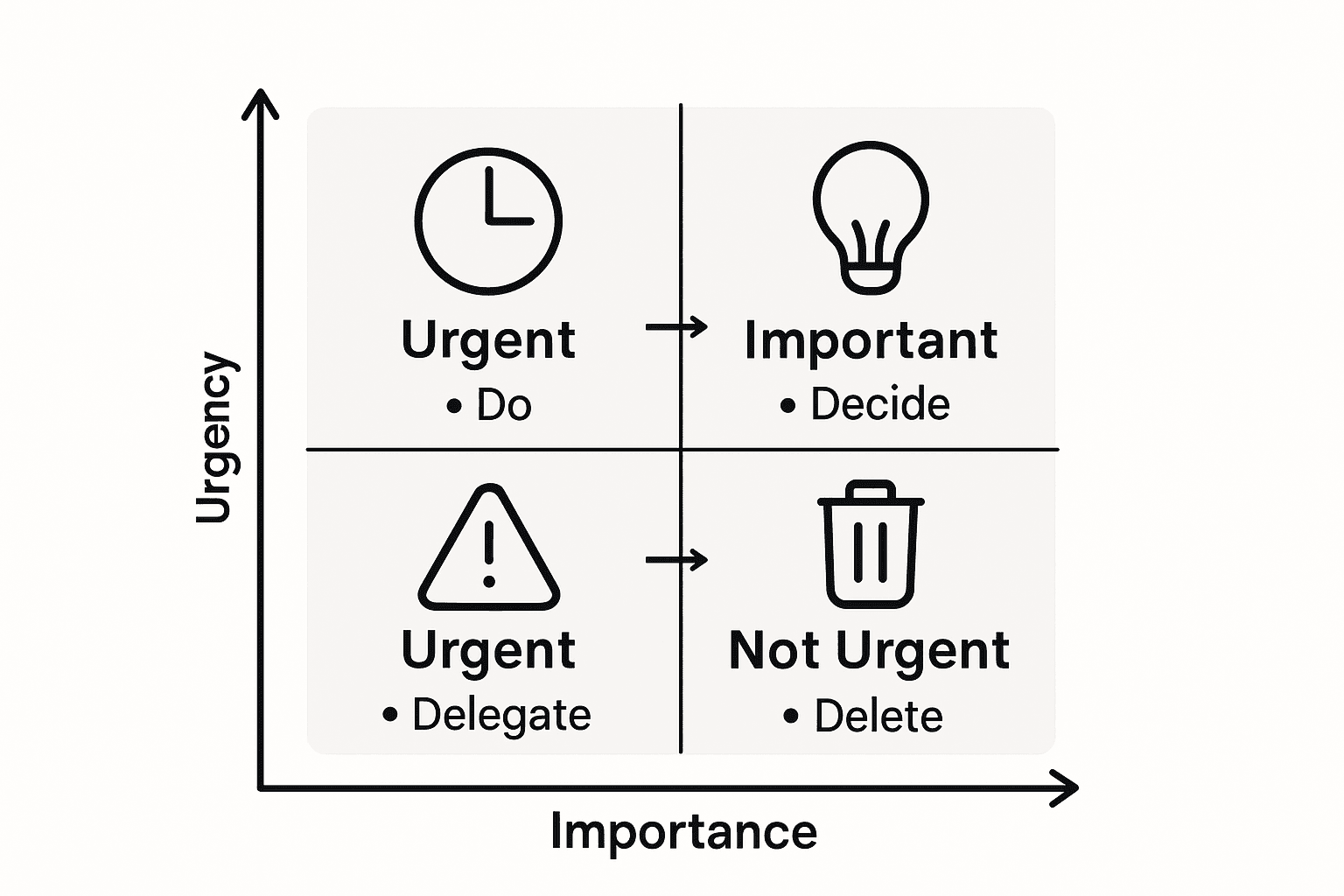
At its core, the task quadrant system evaluates work through two critical dimensions: urgency and importance. Tasks are plotted on a grid with these intersecting axes, creating four distinct categories that guide strategic prioritization. The quadrants represent different task types: urgent and important tasks requiring immediate attention, important but not urgent tasks needing scheduled planning, urgent but less important tasks suitable for delegation, and tasks that are neither urgent nor important and can potentially be eliminated.

Unlike traditional to-do lists that simply track activities, task quadrants leverage an integral framework that provides a holistic view of work responsibilities. This approach helps professionals move beyond reactive task management toward proactive strategic planning. By understanding which tasks truly drive meaningful outcomes, individuals can allocate their cognitive resources more effectively, reduce stress, and create sustainable productivity strategies that align with broader professional goals.
Pro Tip: Task Prioritization Strategy – Spend at least 80% of your weekly work time focusing on Quadrant 2 tasks (important but not urgent), which drive long-term professional growth and strategic objectives while preventing future crisis management.
Breaking Down the Four Distinct Quadrants
The Eisenhower Matrix divides tasks into four distinct quadrants, each representing a unique combination of urgency and importance that fundamentally transforms how professionals approach work management. Task categorization models like these provide a strategic framework for understanding and prioritizing work activities across different complexity levels.
The four quadrants are strategically defined as follows:
- Quadrant 1: Urgent and Important Tasks
- Characterized by immediate deadlines
- Crisis-driven activities
- Requires direct personal attention
- Examples: Emergency projects, critical client issues, pressing health matters
- Quadrant 2: Important but Not Urgent Tasks
- Strategic long-term planning activities
- Personal development and growth initiatives
- Preventative work that reduces future emergencies
- Examples: Professional training, relationship building, strategic planning
- Quadrant 3: Urgent but Not Important Tasks
- Interruptions and distractions
- Activities that feel pressing but don’t contribute to core goals
- Best candidates for delegation
- Examples: Some meetings, certain emails, administrative paperwork
- Quadrant 4: Neither Urgent Nor Important Tasks
- Time-wasting activities
- Low-value interactions
- Tasks to be minimized or eliminated
- Examples: Excessive social media, unnecessary browsing, unproductive conversations
These quadrants offer more than a simple organizational tool; they represent a comprehensive approach to understanding work priorities. Strategic grid models demonstrate how systematic task categorization can dramatically improve professional effectiveness by helping individuals focus their energy on high-impact activities.
Pro Tip: Quadrant Audit Strategy – Conduct a weekly review of your task list, ruthlessly moving or eliminating tasks from Quadrants 3 and 4, and intentionally scheduling more time for Quadrant 2 activities that drive meaningful progress.
Here’s a concise overview of how each task quadrant affects workflow and productivity:
| Quadrant | Typical Focus | Impact on Productivity | Ideal Action |
|---|---|---|---|
| Urgent & Important | Crisis management | High stress, immediate gains | Address immediately |
| Important, Not Urgent | Growth and prevention | Sustainable improvement | Schedule priority |
| Urgent, Not Important | Distractions/interruptions | Drains focus, low long-term value | Delegate quickly |
| Not Urgent, Not Important | Time-wasters | Reduces productivity | Eliminate or minimize |
How Task Quadrant Prioritization Works
Task quadrant prioritization is a systematic approach to organizing work that transforms how professionals manage their time and energy. Unlike traditional to-do lists that simply catalog tasks, this method provides a strategic framework for evaluating and addressing work responsibilities based on their relative urgency and importance.
The prioritization process follows a strategic decision-making workflow:
- Evaluate Task Characteristics
- Assess each task’s immediate urgency
- Determine the task’s overall importance to long-term goals
- Consider potential consequences of delaying or neglecting the task
- Categorize Tasks Systematically
- Plot tasks into their corresponding quadrant
- Assign immediate action steps based on quadrant placement
- Create targeted strategies for handling tasks in each category
The real power of task quadrant prioritization emerges from its ability to help professionals make intentional choices. Integral theory suggests that effective prioritization requires considering multiple perspectives beyond simple time management, integrating personal goals, organizational needs, and long-term strategic objectives.
By consistently applying this method, professionals can shift from reactive task management to proactive goal achievement. The approach enables individuals to spend more time on high-impact activities, reduce stress from constantly fighting fires, and create a more structured approach to personal and professional productivity.
Pro Tip: Prioritization Practice – Spend 15 minutes every evening reviewing and recategorizing your tasks, ensuring you’re consistently realigning your efforts with your most important goals and minimizing time spent in low-value quadrants.
Real-World Productivity Applications and Benefits
Time management strategies like task quadrants have transformative potential across multiple professional domains, helping individuals and organizations optimize their workflow and strategic focus. By providing a structured approach to task evaluation, this method allows professionals to move beyond reactive work patterns and develop more intentional productivity strategies.
Real-world applications span diverse professional contexts:
Professional Settings
- Project managers strategically allocating team resources
- Entrepreneurs prioritizing business development activities
- Remote workers balancing multiple concurrent responsibilities
- Freelancers managing client projects and personal development
Organizational Benefits
- Reduced operational inefficiencies
- Clearer communication about task priorities
- More predictable project timelines
- Enhanced individual and team performance
Integral theory demonstrates that comprehensive prioritization requires considering multiple perspectives, ensuring that task management goes beyond simple time tracking. This holistic approach means professionals can simultaneously address immediate operational needs while maintaining alignment with long-term strategic objectives.
The quadrant method’s power lies in its ability to convert abstract productivity concepts into actionable strategies. By systematically evaluating tasks through urgency and importance lenses, professionals can dramatically reduce decision fatigue, minimize time wasted on low-value activities, and create more intentional, goal-oriented work environments.
Pro Tip: Quarterly Productivity Audit – Schedule a comprehensive review every three months to reassess your task management approach, identifying patterns of productivity and areas where your quadrant strategy can be further refined.
Pitfalls and Common Mistakes to Avoid
Time management strategies require careful implementation to avoid potential productivity traps that can undermine their effectiveness. Professionals often encounter subtle yet significant challenges when attempting to apply task quadrant methodologies, which can inadvertently create more complexity instead of simplifying work processes.
Common Pitfalls Include:
- Misclassifying Task Urgency
- Overestimating task importance
- Treating non-critical tasks as emergencies
- Creating unnecessary psychological pressure
- Rigid Quadrant Adherence
- Treating the matrix as an inflexible rulebook
- Ignoring context and nuanced work dynamics
- Failing to adapt the framework to individual work styles
Integral theory highlights the importance of maintaining a balanced perspective when managing tasks across different dimensions. Many professionals make the critical error of fixating on a single quadrant, which leads to incomplete task management and potential strategic blindspots.
Successful quadrant implementation requires continuous refinement and honest self-assessment. Professionals must develop the skill of objectively evaluating their tasks, resisting the temptation to artificially inflate task importance or urgency. This means creating a dynamic system that evolves with changing work requirements and personal productivity patterns.
Pro Tip: Quadrant Calibration – Conduct a monthly self-audit of your task categorization accuracy, honestly reviewing instances where you might have misclassified tasks and adjusting your approach accordingly.
This table summarizes key strategies and common mistakes in applying the task quadrant method:
| Strategy | Purpose | Common Mistake | How to Avoid |
|---|---|---|---|
| Weekly quadrant audit | Refine task categorization | Ignoring misclassified tasks | Regular self-review |
| Prioritizing Quadrant 2 | Invest in long-term objectives | Spending too little time there | Pre-schedule sessions |
| Adapting framework | Match personal work style | Following matrix too rigidly | Allow flexibility |
| Monthly calibration | Increase accuracy of assessments | Inflating task urgency | Honest reflection |
Master Task Quadrants with Ease Using TaskQuadrant.io
Feeling overwhelmed by the constant battle between urgent and important tasks The challenge of correctly prioritizing your workload can drain your focus and reduce productivity. This article highlights the crucial need to shift from reactive task management to a strategic approach using the Eisenhower Matrix. If you want to avoid common pitfalls like misclassifying tasks or spending too much time in low-value activities, a robust tool can make all the difference.
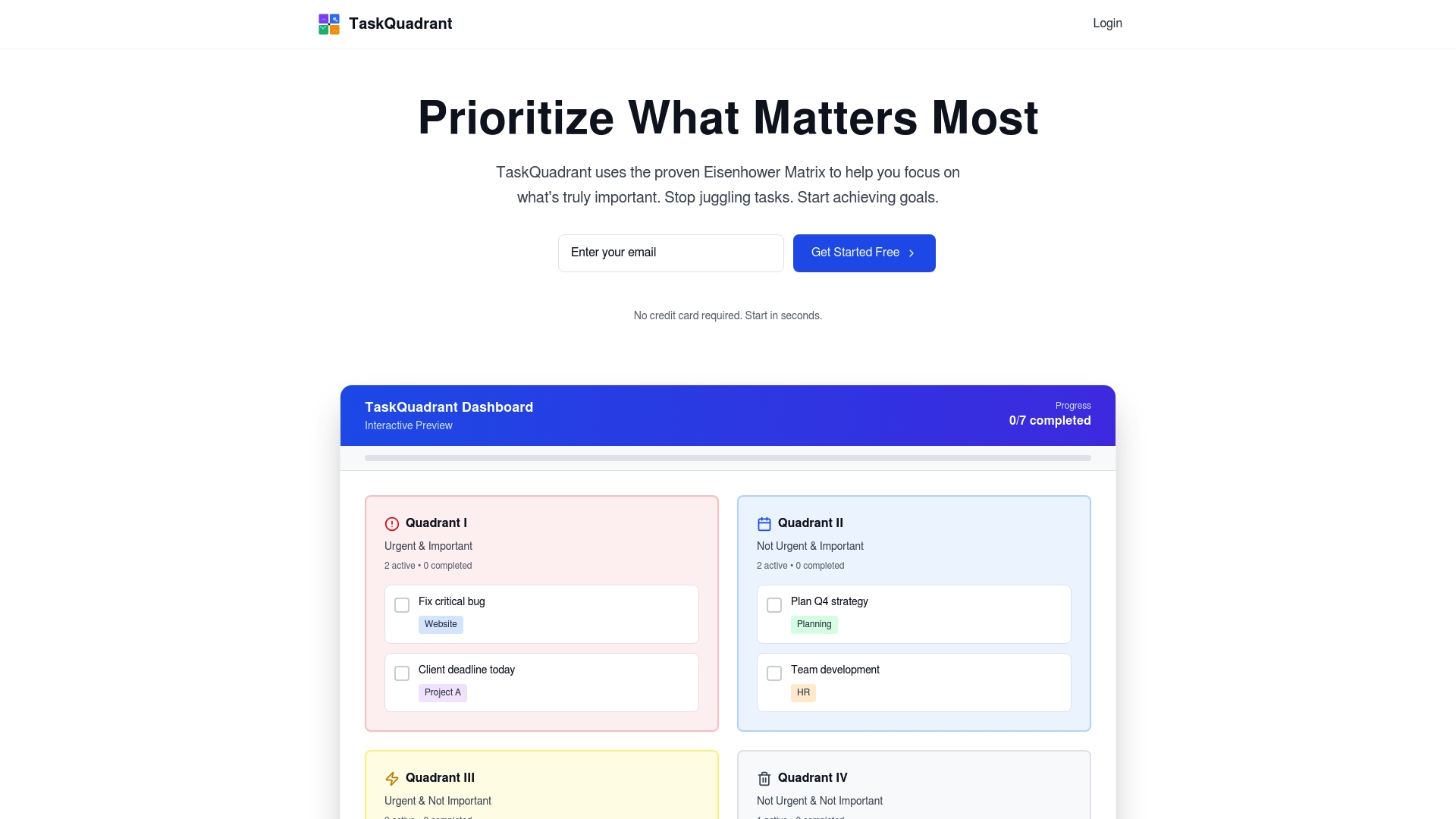
Unlock a new level of productivity with TaskQuadrant.io, a platform designed exactly to help you apply task quadrant principles effortlessly. Whether you want to categorize tasks manually or generate them from visual mind maps, the platform automatically sorts your work by urgency and importance so you spend your energy where it truly matters. Start prioritizing your Quadrant 2 activities to drive sustainable growth and reduce constant firefighting. Take control of your time today by visiting TaskQuadrant.io and try our easy onboarding that gets you productive from day one.
Frequently Asked Questions
What are task quadrants?
Task quadrants are a strategic framework designed to categorize work activities based on their urgency and importance. This system helps professionals prioritize tasks and manage time effectively by dividing tasks into four categories: urgent and important, important but not urgent, urgent but not important, and neither urgent nor important.
How can I use task quadrants to improve productivity?
You can improve productivity by focusing 80% of your work time on tasks in Quadrant 2 (important but not urgent). This approach helps you invest in long-term goals, personal growth, and proactive planning, ultimately reducing stress and preventing crises.
What should I do with tasks that fall into Quadrant 3 and Quadrant 4?
Tasks in Quadrant 3 (urgent but not important) should be delegated or minimized where possible, as they distract from core objectives. Tasks in Quadrant 4 (neither urgent nor important) should be eliminated or significantly reduced to maximize your productivity.
How often should I review my task quadrants?
It’s recommended to conduct a weekly review of your task list. This helps you reassess your prioritization, move or eliminate tasks in Quadrants 3 and 4, and ensure you spend adequate time focusing on Quadrant 2 activities.
Recommended
- TaskQuadrant Features – Eisenhower Matrix, Projects & Analytics
- TaskQuadrant – Professional Task Management with Eisenhower Matrix
- TaskQuadrant Landing – Eisenhower Matrix Task Management
- Security – TaskQuadrant Data Protection & Privacy
- Understanding Why Manage Tasks for Better Productivity – Optio Station: Best Project Management App for Prioritization
Leave a Reply